
How Rubber Rollers Function in Industrial Operations
Rubber rollers have become an essential part of the modern industrial processes that demand speed. They are also used in a wide range of industries, including textiles, paper, packaging, printing, and plastics, where the rollers have a wide variety of applications in process automation, increased levels of precision, and uniformity of material production. Rubber rollers are essential for any production line that requires high-quality standards, starting with transporting raw materials and extending to the process of surface finishing.
This blog will discuss the primary uses of rubber roller manufacturers and why they are so useful in modern manufacturing with regard to efficiency and performance.
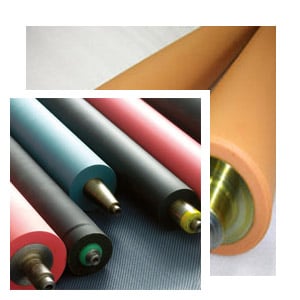
1. Web Handling & Material Transport
Conveying material is one of the main functions of rubber rollers. The rollers provide an even and smooth movement of continuous pieces of fabric, paper, film, or foil (webs). Their rubberized tops enable them to have an appropriate friction to hold the material without damage.
Application
- Textile rolling machines
- Paper and plastic film lines
- Packaging conveyors
Benefits
- Reduces misalignment or slippage
- Blocks creasing and wrinkling
- Enables high tension control through high-speed processing
2. Compression and Pressure Application
Rubber rollers also fulfill a compressive role, putting a controlled pressure on such processes as laminating, pressing or bonding. With a large area contact, they can guarantee the same pressure all over.
Application
- Films and foils lamination
- Adhesive bondage in packaging
- Plywood manufacturing and veneer pressing
Benefits
- Appropriate sticking or bonding
- Greater product finish
- Minimizes the air bubbles or flaws during laminating
3. Support of Coating and Lamination
On lamination lines and coating lines, coatings or adhesives are evenly spread across a substrate, such as paper, fabric or plastic, using rubber rollers. They are used in pairs with steel rollers or doctor blades to maintain the accuracy of the coating thickness.
Application
- Paper coating units
- BOPP/CPP film lamination
- Printing and finishing of textiles
Benefits
- Even coating application
- Reduces chemical or adhesive wastage
- Suitable for high-speed roll-to-roll production
4. Polishing and Finishing
Rubber rollers are also useful in making finished products look good. Embossing, polishing or glossing are handled with specially designed rubber rollers to produce the desired textures and finish of the surface.
Application
- Leather and vinyl finishing
- Textile calendaring
- Surface texturing or polishing of a metal
Benefits
- Enhances the aesthetics of the product
- Adds value to manufactured products
- Allows custom work on-screen printing
5. Processing & Guiding Material
Rubber rollers ease the processing of materials in terms of their guidance, alignment, and support in processing; slitting, rewinding and sheet cutting to be precise. Their elasticity and shock-absorption ability predispose them to be used at the most important contact points of the fast-moving lines.
Application
- Slitting machines
- Rewinders/unwinders
- Corrugating and die cutting installations
Benefits
- Covers delicate or in-shade printing
- Answers vibration and minimizes wear of the equipment
- Provides precision cutting and alignment
Application Of Rubber Roller
- Rubber Roller For Foil Industries
- Rubber Roller For Tyre-Tube
- Rubber Roller For Textile Industries
- Rubber Roller For Rice Mill
- Rubber Roller For Plastic Industries
- Rubber Roller For Paper Industries
- Rubber Roller For Packaging Industries
- Rubber Roller For Metal Industries
- Rubber Roller For Leather Industries
Why are Rubber Rollers Important in the Manufacturing Process?
It can be used at the industrial level thoroughly, as it has a high load-bearing capacity
Works well in high temperatures and in the presence of chemicals
The normally long life of this type of paving material translates into a low deterioration during use (wear-and-tear), which means low maintenance costs.
Nitrile, EPDM, Silicone, Neoprene and Natural Rubber adapted to the pre-requisites of the process
The Industries that depend on rubber rollers
Textile Industry: Calendaring, dying and finishing
Paper and Printing: The transfer of ink to the paper, the coating, and the feeding of ink to the paper
Packaging Industry: Lamination, bonding, and slitting
Web guiding and film thickness management: Web guiding and controlling thickness: Film thickness management:
Polishing-pressing and surface enhancing in the metal & Plywood Industry
Conclusion
Printing Rubber rollers are seemingly basic, but their roles are critical in ensuring productivity, quality of products and stability of operation among industries. With the need of automation and accuracy being more critical than before, manufacturers can benefit hugely by investing in quality, custom rubber rollers.